
SMS OTP Alternatives in 2026: What Leading Companies Are Implementing
June 30, 2026·Azat Eloyan
SMS OTP had a good run as the default verification method. It works on any phone, needs no app, and most users know exactly what to do when a six-digit code lands in their messages. For years, that was enough.
In 2026, it's showing its age. Businesses running SMS-based authentication are dealing with per-message costs that have climbed across major markets, fraud attacks that inflate OTP traffic with hundreds of thousands of fake requests overnight, carrier filters that occasionally swallow legitimate codes whole, and users who expect verification to be instant.
What leading companies have figured out is that no single channel has to carry all the weight. WhatsApp, Viber, Telegram, voice calls, flash calls, and email each cover different regions, devices, and use cases. Most serious verification setups today combine two or more of these into layered flows: a fast, cost-efficient primary channel and a reliable fallback when the first attempt doesn't land.
This guide covers each SMS OTP alternative in depth, how it works, where it fits, and where it doesn't, plus how to think about building a multi-channel verification strategy that holds up across different regions, devices, and user types.
Why Businesses Are Looking Beyond SMS OTP
SMS OTP still works for a lot of use cases. But costs are rising, fraud is getting harder to ignore, and delivery isn't as reliable as it used to be. Here's what's actually pushing businesses to look at other options.
Rising Authentication Costs
SMS has always carried a per-message cost, but the numbers have moved in the wrong direction. A2P messaging fees have increased across major markets, carriers in the US, UK, and parts of Southeast Asia have added registration requirements and surcharges, and pricing in emerging markets can spike without warning when grey routes get shut down.
For businesses running high-frequency verification, those costs add up fast. A platform sending 10 million OTPs a month at $0.05 per message is spending $500,000 a year on SMS alone. Even shifting a portion of that traffic to cheaper channels makes a meaningful difference.
SMS Pumping Fraud and Artificial Traffic Inflation
SMS pumping fraud (also called artificially inflated traffic, or AIT) is one of the more damaging threats in authentication right now. Bad actors control or collude with premium-rate phone numbers, trigger your OTP flow repeatedly using those numbers, and collect a cut of the carrier revenue your platform ends up paying for.
The damage can happen fast. Some businesses have seen fraudulent OTP spikes of hundreds of thousands of requests within a few hours, with nothing to show for it but a large carrier bill.
Carrier Filtering and Delivery Delays
Carrier spam filters have gotten more aggressive, and they aren't always accurate. Legitimate OTP messages get flagged, especially on shared short codes where another sender's behavior can affect your deliverability. Dedicated short codes reduce that risk, but they come with higher costs and longer setup times.
Even without filtering, delivery isn't guaranteed. Routing inefficiencies and network congestion mean some users wait far too long for a code that may never arrive. OTP delivery failures at checkout or login lead to users abandoning the purchase or the session.
User Experience Expectations in 2026
A lot of users have now experienced auto-read OTPs, one-tap verification, and biometric authentication. Compared to those, waiting for an SMS and typing in a code manually feels noticeably slow.
Verification friction shows up in drop-off rates. The gap between a flash call that verifies automatically in two seconds and a manual SMS code entry can translate into multiple percentage points of conversion loss, especially on mobile at high-volume moments like signup or checkout.
The Shift Toward Multi-Channel Verification
The clearest change in how authentication-mature companies operate is the move away from single-channel thinking. The goal is to route each verification to the channel most likely to succeed for that user, in that region, on that device, at that cost. SMS becomes one option in a broader toolkit, selected when it's the best fit, and replaced or backed up when it isn't.
What Makes a Good SMS OTP Alternative?
Not every SMS OTP replacement is a straight upgrade. Some channels are faster but have limited reach. Others are cheaper but depend on internet access. Before diving into the options, here are the criteria worth measuring each one against.
Delivery Reliability
Can the message consistently reach the user? This means accounting for internet dependency, exposure to carrier filtering, regional infrastructure quality, and how the channel holds up when conditions aren't ideal. High average delivery rates are useful, but what matters just as much is performance in the edge cases, because that's where most verification abandonment happens.
Verification Speed
How quickly does the code reach the user after the trigger? Speed matters most at high-stakes moments: checkout, login, account recovery. A slow verification puts the user in a waiting state mid-flow, and a lot of them won't wait long.
User Experience and Conversion Rates
A verification method that users find confusing, can't receive, or have to work too hard to complete will show up in your conversion numbers. The best channels keep the required steps to a minimum and fit naturally into the context where the user already is.
Security and Fraud Resistance
Each channel has its own attack surface. SMS is exposed to SIM swap attacks, SS7 interception, and OTP forwarding malware. Other channels carry different risks. A good alternative should reduce the fraud vectors most relevant to your business, not introduce a new set of problems.
Global Reach and Coverage
A channel that performs well in Western Europe might have minimal relevance in Southeast Asia. User adoption, platform availability, and local regulations all affect real-world reach. For global businesses, this is often the most complex part of the evaluation and the one most likely to push toward multi-channel setups.
Cost Efficiency
Per-verification cost matters, but so does the full picture: setup overhead, failure rates, retry costs, and the hidden cost of abandonment when delivery misses. A channel that's cheap per attempt but unreliable can end up costing more in total than a slightly pricier one that delivers consistently.
WhatsApp OTP Verification
WhatsApp OTP verification has become one of the most widely adopted SMS alternatives, particularly in markets where WhatsApp is the primary messaging app. With over two billion active users globally, the reach is there. So is the infrastructure.
How WhatsApp OTP Works
When a user needs to verify their identity, the business sends an OTP to the user's WhatsApp account via the WhatsApp Business API. The message arrives like any other WhatsApp message. On many Android devices, the code can be auto-read if the app has the necessary permissions, completing verification without the user lifting a finger. On other devices, the user opens WhatsApp, reads the code, and types it in.
The whole thing runs over the internet rather than carrier networks, which is what separates it from SMS at the infrastructure level.
Advantages of WhatsApp Verification
In markets like Brazil, India, Nigeria, Saudi Arabia, and most of Southeast Asia, WhatsApp is where people actually spend their time. Messages sent there tend to get seen faster than SMS, and delivery runs over internet infrastructure, which means no carrier filtering and no exposure to SMS pumping fraud.
Costs are also typically lower than SMS, sometimes significantly so in regions where A2P messaging rates are high. And because WhatsApp supports rich message formatting, businesses can include branding, context, or a support link alongside the OTP, which can help with user trust and completion rates.
Potential Limitations
WhatsApp OTP only works if the user has a WhatsApp account and an active internet connection. In markets where WhatsApp isn't widely used, or among users who aren't on the platform, it simply won't reach them.
Businesses also need to go through Meta's WhatsApp Business API approval process, including setting up a verified business account and following WhatsApp's messaging guidelines. It's an extra step compared to a basic SMS setup. WhatsApp is also unavailable in China, which is worth factoring in for businesses with users there.
Best Use Cases
WhatsApp OTP is a strong primary channel for consumer apps, e-commerce platforms, and fintech services operating in Latin America, MENA, South Asia, or Southeast Asia. It also works well as the first option in a fallback flow for any business where users are mobile-first and active on the platform.
Viber OTP Verification
Viber OTP follows a similar model to WhatsApp OTP but serves a different part of the world. If your users are in Eastern Europe, the Philippines, or parts of MENA, Viber is likely already their go-to messaging app, which makes it a natural fit for OTP delivery.
How Viber OTP Works
The business sends a verification code to the user's Viber account via the Viber Business Messages API. The user receives it as a standard Viber message, reads the code, and enters it in the verification field. Like WhatsApp, delivery runs over the internet rather than carrier networks, so it bypasses SMS routing entirely.
Getting set up requires a verified Viber Business account and API access through an authorized partner.
Advantages of Viber Authentication
In Viber's core markets, it often sees higher daily active usage than WhatsApp, which means better open rates and faster verification completion. Because it delivers over the internet, it avoids carrier filtering and has no exposure to SMS pumping fraud. Costs are generally lower than SMS, and Viber Business messages support branding elements, so the verification experience can be tailored to match your product.
Potential Limitations
Outside of Viber's stronghold markets, reach drops off quickly. It's not a channel that scales globally on its own, so businesses using Viber OTP as a primary channel will need SMS or another option as a fallback for users outside those regions.
Best Use Cases
Viber OTP is a strong primary channel for businesses with meaningful user bases in Eastern Europe, particularly Bulgaria, Greece, Ukraine, and Belarus, as well as the Philippines and parts of MENA. It works well for regional e-commerce platforms, financial services, and any business looking to reduce SMS costs in markets where Viber has strong adoption.
Telegram OTP Verification
Telegram OTP is a good fit for a specific kind of audience: technically savvy users who are already active on the platform. It's not the widest-reaching channel on this list, but in the right markets and for the right products, it performs well.
How Telegram Verification Works
Telegram OTP is delivered through a Telegram bot. The business integrates with a bot, and when a user needs to verify, the code is sent as a bot message directly in their Telegram app. One thing to know upfront: users need to have started a conversation with the bot before it can message them. Telegram's anti-spam design prevents bots from initiating contact cold, so the user has to take that first step.
Advantages of Telegram OTP
Telegram has a strong reputation for security and privacy, which tends to resonate well with crypto communities, developer audiences, and tech-forward users. In Russia and several CIS countries, it's one of the dominant messaging platforms, giving it regional reach that WhatsApp and Viber don't have in those markets. Delivery runs over the internet, so there's no carrier filtering and no SMS pumping exposure. Costs are also low compared to SMS.
Potential Limitations
The bot opt-in requirement is the main friction point. Because users have to initiate contact with the bot first, Telegram OTP isn't practical as a first-touch verification channel for new users. It works much better for returning users who already have an established connection with the bot.
Telegram's user base also skews toward specific demographics. For mainstream consumer apps serving a broad, general audience, adoption rates may not be high enough to support it as a primary channel.
Best Use Cases
Telegram OTP is a natural fit for crypto exchanges, blockchain platforms, developer tools, and fintech apps with technically sophisticated users. It also works well for businesses operating primarily in Russia, Ukraine, or CIS markets, and for platforms where users are already engaging with the product through Telegram communities or support channels.
Voice OTP Verification
Voice OTP is the most universally accessible verification channel on this list. No smartphone, no messaging app, no internet connection required. If a user has a phone that can receive calls, voice OTP can reach them.
How Voice OTP Works
When a user needs to verify, the platform places an automated call to their phone number. A text-to-speech system reads the one-time code aloud, usually repeating it two or three times. The user then enters the code into the verification field. It works on any device capable of receiving a phone call.
Advantages of Voice Authentication
Voice OTP reaches users that most other channels can't: people with basic feature phones, users in low-data coverage areas, and older users who aren't comfortable with messaging apps. For businesses serving a wide range of demographics, that coverage matters.
Because voice calls travel through a different network pathway than SMS, voice OTP also sidesteps SMS pumping fraud entirely. In some regions, voice delivery is actually more consistent than SMS, which makes it a reliable fallback in markets where carrier filtering affects text delivery.
Potential Limitations
Voice OTP costs more per verification than SMS in most markets and requires more from the user: they need to answer the call, listen carefully, and type in what they heard. In noisy environments or areas with poor call quality, that gets harder.
Voicemail interception is also worth keeping in mind. If a user's voicemail isn't PIN-protected, someone with access to the number could retrieve the code from a missed call recording.
Best Use Cases
Voice OTP works best as a fallback for users who can't receive SMS or app-based codes, in banking and healthcare where accessibility coverage is important, and in markets where voice delivery outperforms SMS.
Flash Call Verification
Flash call verification takes a different approach to OTP delivery. The code isn't sent in a message. It's the phone number that calls you.
How Flash Call Verification Works
The platform places a call to the user's number that disconnects after one or two rings. The caller ID of that incoming call is the OTP. On Android, apps with call log permissions read the caller ID automatically and verify the user with no input needed. On iOS, where call log access is restricted, the user enters the last few digits of the missed call number manually.
Advantages of Flash Calls
On Android, verification completes in a couple of seconds with zero user action. No waiting, no typing, no switching apps. That speed shows up directly in conversion rates, especially for on-demand apps where a slow signup flow loses users before they even get started. Flash calls also cost less than SMS in most markets and carry much lower fraud exposure since the call is never answered.
Potential Limitations
The automatic experience is Android-only. iOS users have to complete a manual step, so a fallback channel is needed to keep conversion consistent across both platforms.
Best Use Cases
Flash calls work particularly well for on-demand apps like ride-hailing, food delivery, and logistics, and in markets like India and Indonesia where Android dominates and keeping cost-per-verification low is a real operational priority.
Email OTP Verification
Email OTP verification is the most universally available option on this list. Every user with an online account has an email address, which gives it a baseline reach that no other channel can match.
How Email OTP Works
When a user needs to verify, the platform sends a one-time code to their email address. The user opens their inbox, finds the message, and enters the code in the verification field. Some implementations send a magic link instead of a numeric code, which reduces the process to a single click.
Advantages of Email Authentication
Email works across every device and region, with no carrier dependency and no app required. For SaaS platforms and desktop-first products, it fits naturally into the workflow users are already in. Cost per verification is also very low, and when magic links are used, the experience can be genuinely smooth. It holds up well for low-risk flows, though email OTP and SMS each have clear strengths in different contexts, which is worth keeping in mind when deciding how to weight them in a multi-channel setup.
Potential Limitations
Email isn't built for speed. Inbox delays can range from a few seconds to several minutes, and spam filters occasionally swallow OTP emails before they arrive. For time-sensitive verification moments like login or checkout, that latency is a real drawback.
Email also doesn't confirm that the user has access to a physical device, which limits its usefulness in multi-factor setups where device possession is part of the security model.
Best Use Cases
Email OTP is a solid choice for SaaS platforms, B2B tools, and desktop applications where users are already working from a computer with their inbox open. It also suits account creation flows and low-urgency confirmations where real-time delivery isn't critical.
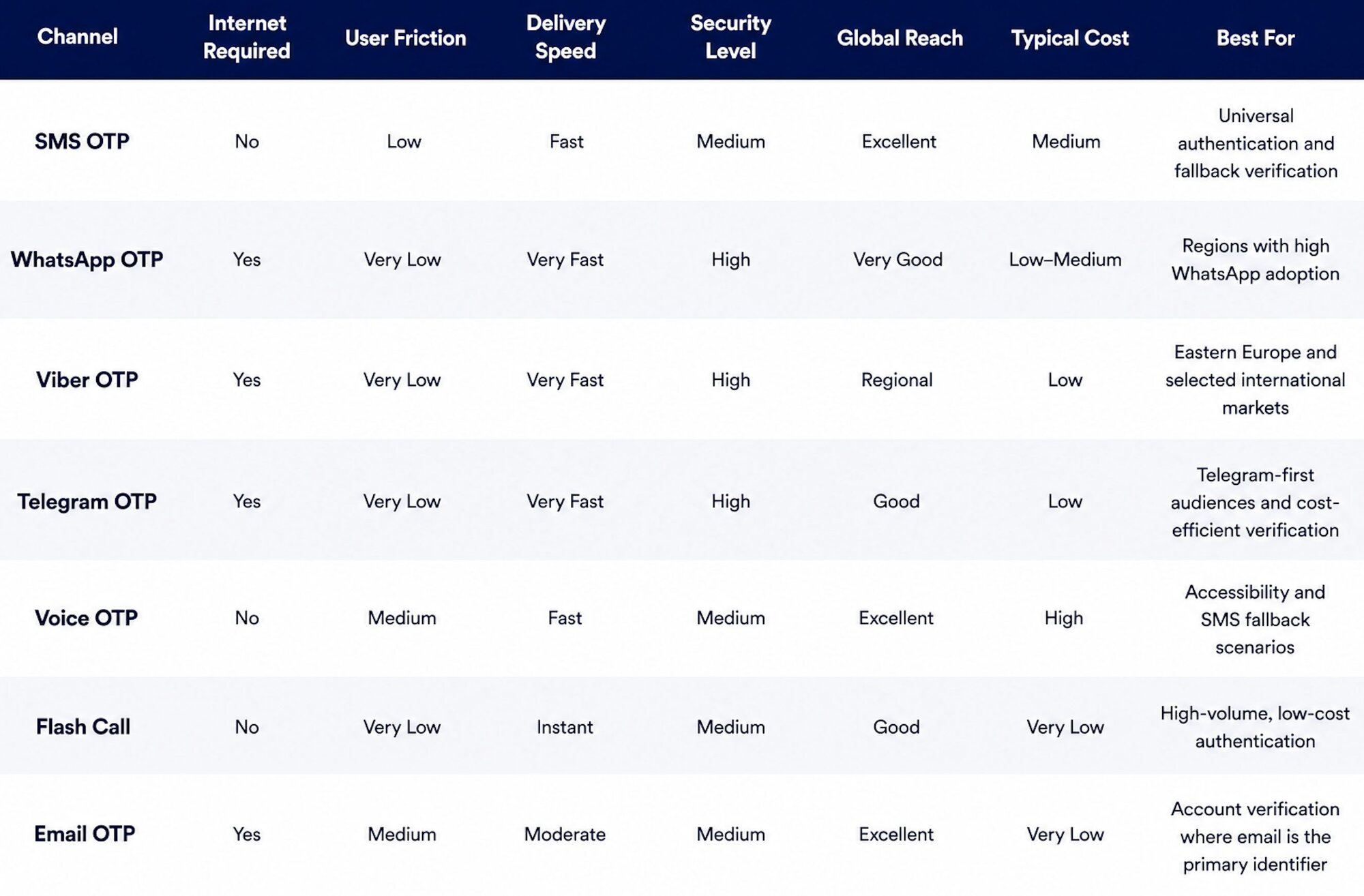
SMS OTP vs. Popular Authentication Alternatives
Each alternative to SMS OTP has a different strength. This section breaks down the key trade-offs so you can see clearly where SMS holds up and where another channel is likely to serve you better.
SMS OTP vs. WhatsApp OTP
SMS reaches any phone without the internet. WhatsApp needs both an account and a data connection, but in markets like Brazil, India, and most of MENA, it delivers faster, costs less, and has no carrier fraud exposure. In high-adoption markets, WhatsApp is typically the stronger primary channel with SMS as backup.
SMS OTP vs. Viber OTP
SMS has broader global reach, but in Eastern Europe and parts of Southeast Asia, Viber outperforms it on both delivery and cost. Most businesses use Viber as the primary channel in those markets and SMS everywhere else.
SMS OTP vs. Telegram OTP
SMS wins on reach. Telegram wins on cost and security reputation, but the bot opt-in requirement limits it to returning users. It works well on platforms where users are already engaged with Telegram, less so as a first-touch verification channel.
SMS OTP vs. Voice OTP
Both run on carrier networks with similar global reach. Voice costs more and requires more from the user, but it reaches people who can't engage with a text message and avoids SMS pumping entirely. It's best treated as a high-reliability fallback for specific user segments.
SMS OTP vs. Flash Call Verification
Flash calls are faster, cheaper, and more fraud-resistant than SMS for Android users. The gap is on iOS, where a manual step is required. In Android-dominant markets, flash calls can take over as the primary channel with SMS as the fallback.
SMS OTP vs. Email OTP
SMS suits real-time, mobile-native verification. Email suits desktop flows and lower-urgency confirmations. Most businesses use both, with the context determining which one is triggered.
Comparison Table: Authentication Channels at a Glance
How Leading Companies Build Multi-Channel Authentication Flows
Multiple channels only pay off when they're connected into a flow that's fast, cost-efficient, and reliable. Here's how companies are doing it in practice.
Primary Verification Channel + Fallback Logic
Most setups start with a preferred primary channel and trigger a fallback automatically if the first attempt fails or times out. A consumer app in Southeast Asia might try flash call first, move to WhatsApp if the call doesn't connect, then drop to SMS as the final safety net. Most users get verified on the first attempt. The rest are still covered.
Intelligent Channel Selection
More advanced platforms select the channel at the point of trigger using real-time signals: device type, country code, and verification history. An Android user in India gets a flash call. A user in Brazil on iOS gets WhatsApp. A user in Germany with no WhatsApp activity gets SMS. The logic runs silently in the background.
Regional Authentication Strategies
Many global businesses define channel hierarchies by region. Eastern European users go through Viber first. Southeast Asian users get WhatsApp or flash calls depending on the country. CIS markets get Telegram. Simple rules, applied consistently, capture most of the cost and performance benefits without complex per-session routing logic.
Reducing Verification Abandonment
Most abandonment comes down to one thing: the code didn't arrive fast enough. Multi-channel flows fix this by using the fastest available channel first and switching automatically when delivery stalls, without any action needed from the user.
Choosing the Right OTP Alternative for Your Business
The best channel depends on who your users are, where they are, and how they interact with your product. Here's a quick breakdown by industry.
SaaS Platforms
Email OTP is a natural fit for desktop-first users who are already working from their inbox. For login and higher-security actions, SMS or WhatsApp adds a stronger second factor. Multi-channel routing is worth setting up early if the user base spans multiple regions.
Fintech and Banking
Reliability and compliance come first. SMS covers most regulatory requirements, voice OTP handles accessibility, and flash calls add speed for mobile-first flows in Android-dominant markets. Fraud prevention controls are non-negotiable at this tier.
eCommerce and Marketplaces
Conversion is the priority. Flash calls and WhatsApp OTP tend to perform best in mobile-first markets, where reducing friction at checkout directly impacts revenue. Regional routing matters a lot for global platforms.
On-Demand Apps
Speed at signup is critical. Flash call is the go-to primary channel in Android-dominant markets, with SMS as the universal fallback. These businesses benefit most from high-throughput, cost-optimized verification flows.
Healthcare and Customer Portals
User demographics vary widely here. Voice OTP is often essential for older or less tech-savvy users, and email works well for lower-sensitivity actions like appointment confirmations. Clarity and simplicity in the verification experience matter more than speed.
Why Businesses Use GetOTP for Multi-Channel Verification
GetOTP gives businesses everything they need to run a multi-channel verification strategy from a single platform. Here's what that looks like in practice.
SMS, WhatsApp, Viber, Telegram, Voice, and Flash Call Support
GetOTP supports every major verification channel through one API. No separate integrations, no juggling multiple providers. SMS, WhatsApp, Viber, Telegram, voice, and flash call are all available out of the box, making it easy to expand your channel mix or adjust your strategy as your user base grows.
Intelligent Fallback Logic
Fallback cascades are configured once and run automatically. When a flash call doesn't connect, GetOTP rolls over to WhatsApp. When WhatsApp can't reach the user, it drops to SMS. The whole chain runs without any extra logic on your end.
Global Coverage
GetOTP's network covers over 190 countries with routing optimized for each market. Businesses don't need to manage regional carrier relationships or worry about route optimization. Coverage is handled at the platform level.
Fraud Prevention Controls
Built-in protections against SMS pumping and other OTP fraud patterns come standard. Rate limiting, suspicious traffic detection, and number validation are all part of the default setup, with custom thresholds available for businesses that need tighter controls.
Real-Time Analytics
Every verification attempt, delivery result, and channel fallback is tracked in GetOTP's analytics dashboard. Teams can monitor delivery rates by channel and region, spot drop-off points, and use the data to fine-tune their verification flow over time.
Fast API Integration
GetOTP follows standard RESTful patterns with clear documentation. Most integrations are up and running within a few hours. Webhooks are available for real-time delivery confirmations and status updates.
Build a Multi-Channel Verification Strategy With GetOTP
SMS OTP isn't going away, but running it as your only verification channel is increasingly a liability. Costs are rising, fraud is getting harder to absorb, and delivery isn't reliable enough in enough markets to carry the whole load on its own.
The companies getting verification right in 2026 treat it as a dynamic system. They route users to the channel most likely to succeed for their region, device, and risk profile. They use fallback logic to handle edge cases without sacrificing the economics of faster, cheaper primary channels. And they use real delivery and conversion data to keep improving the flow over time.
Channel diversification isn't a complexity trade-off. For most businesses, it's what makes verification faster, cheaper, and more resilient all at once.
Frequently Asked Questions
What is the best alternative to SMS OTP?
It depends on your users and where they are. Flash call is the fastest and cheapest option for Android-dominant markets. WhatsApp OTP works best in Latin America, MENA, and Southeast Asia. Voice OTP covers users without smartphones or data access. Most businesses get the best results from combining two or more channels.
Is WhatsApp OTP more reliable than SMS OTP?
In high-adoption markets like Brazil, India, and much of the Middle East, yes. WhatsApp delivers over the internet, which means no carrier filtering and no SMS pumping exposure. In markets with lower WhatsApp penetration, or for users without an active internet connection, SMS is still the more reliable option.
Are flash calls cheaper than SMS verification?
In most markets, yes. Flash calls use a missed call rather than a delivered message, which brings the cost per attempt down. Factor in the higher conversion rates from Android auto-verification, and the effective cost per successful verification is often significantly lower than SMS.
Can businesses use multiple OTP channels at the same time?
Yes, and most businesses at scale do. The preferred channel goes first, and secondary channels kick in automatically if delivery fails or times out. More advanced setups use intelligent routing to pick the best channel upfront, which reduces how often fallbacks are needed.
Which OTP method has the highest verification completion rate?
Flash call for Android users. When the code is read automatically from the incoming caller ID, there's no manual step and no drop-off. WhatsApp OTP also performs well in high-adoption markets. SMS tends to lag behind both, mainly due to delivery delays and manual code entry.
Is email OTP secure enough for account verification?
For low-to-medium risk scenarios, yes. It works well for account creation, password resets, and routine login. For higher-security actions, it's less suitable since it doesn't confirm the user has access to a physical device. It's best used as one layer in a broader verification setup.
Tags :
2FA